Getting ready for the 2026 Shift to IPv6 Exclusive Proxy Pools

The State of Online Search Engine Automation in 2026
The technical requirements for collecting data from significant search engines have shifted considerably as 2026 progresses. Legacy systems that depend on narrow pools of IPv4 addresses now deal with installing costs and aggressive blocking mechanisms. The large volume of automated requests required for contemporary market analysis makes traditional proxy approaches nearly difficult to sustain. Engineers are now focusing on IPv6 as the main structure for any massive operation involving automated data retrieval. This transition is not merely about address availability however about the structural benefits that contemporary networking procedures supply to high-capacity bots.
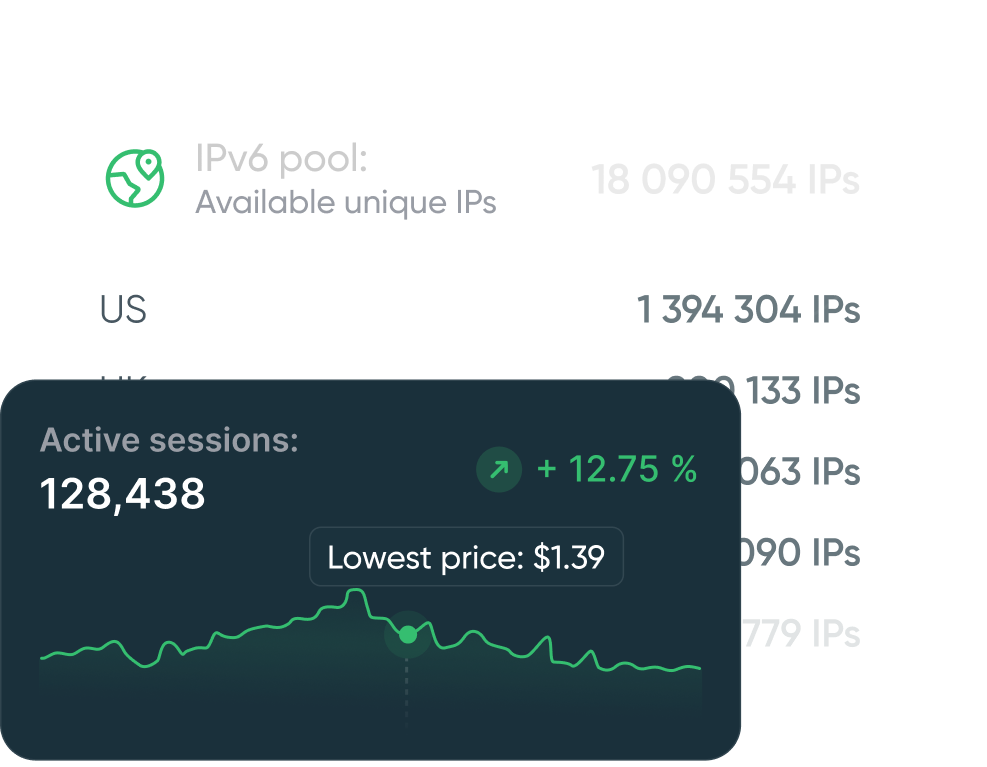
IPv4 exhaustion has reached a vital stage where the rate per address has tripled over the last two years. In the current digital market, companies are discovering that the overhead of preserving thousands of special IPv4 exit points consumes most of their operational spending plan. By contrast, IPv6 uses an essentially limitless supply of addresses, enabling far more aggressive rotation techniques without the risk of exhausting a particular subnet. This unrestricted supply alters the math for developers who require to simulate varied user habits across multiple regions all at once.
Managing Subnet Diversity for high-speed scraping
One of the primary hurdles in 2026 includes how online search engine group and restriction IP addresses. In the past, a restriction might affect a single address or a small range. Now, automated detection systems frequently flag whole/ 64 subnets if they discover suspicious patterns. This requires a more advanced technique to proxy management than simply buying a block of addresses and rotating through them. Organizations are now getting/ 48 and even bigger prefixes to make sure that their traffic appears to stem from a wide array of sources instead of a single datacenter rack.
Strength in 2026 depends on the ability to leap between subnets with zero latency. If a search engine spots a high volume of requests from a specific IPv6 variety, the system needs to be able to quickly move traffic to an entirely various prefix. This level of agility needs a proxy facilities that supports programmatic control over routing tables. Numerous specialized companies concentrated on Asia Virtual Solutions are building their own tunneling protocols to handle these quick shifts. Without this capability, a single detection event could stall a whole data collection project for hours.
Bandwidth Requirements for Information Extensive Jobs in the tech industry
Data payloads are larger in 2026 than they were simply a couple of years ago. Search results page are no longer easy lists of text links. They involve rich media, interactive components, and intricate JavaScript that needs to be rendered to draw out significant info. This increases the bandwidth demand on every proxy node. A proxy network that is not backed by 10Gbps or 100Gbps uplinks will rapidly end up being a traffic jam, resulting in timeouts and incomplete information sets. High-bandwidth facilities is now a requirement for any team attempting to stay competitive in the field of search engine optimization and market intelligence.
Latency also plays an important function in how online search engine view a visitor. Bots that take too long to react or have inconsistent ping times are quickly flagged as non-human traffic. By utilizing IPv6, which was designed with more efficient header processing and routing, developers can shave milliseconds off each demand. These little gains build up when running millions of questions per day. The relocation toward edge-based proxy nodes has further improved this, placing the exit points closer to the online search engine datacenters to reduce the physical range data need to travel.
Techniques for automated ranking checks and Monitoring
Accurate ranking data is harder to get in 2026 due to the fact that search engines have ended up being highly localized. A search carried out in one part of a city might yield different results than a search performed 10 miles away. To record this granularity, automation tools need to use proxies that are geographically tagged with precision. IPv6 makes this simpler by permitting for the assignment of particular addresses to specific geographic collaborates within a network service provider's infrastructure. This allows for a level of hyper-local monitoring that was previously too expensive to carry out with IPv4.
Standardized rotation policies are also evolving. Rather of rotating after every request, which can look suspicious, modern strategies involve "sticky sessions" that last for the period of a normal human surfing session. This needs a proxy swimming pool that is big enough to hold thousands of active sessions without overlap. Those who invest in Asia Virtual Solutions discover that they can keep these sessions more efficiently due to the fact that they aren't completing for a handful of offered addresses with other users. The stability of the connection ends up being just as important as the amount of addresses offered.
Preventing Detection through Natural Traffic Patterns
Online search engine algorithms in 2026 use advanced behavior analysis to distinguish in between real users and automated scripts. They look for patterns in request headers, the order in which resources are filled, and even the "jitter" in mouse motions or scrolling. Proxy networks need to have the ability to deal with these requirements by supporting complete HTTP/3 and QUIC procedures, which are now the standard for web traffic. IPv6 is natively better suited for these protocols, offering a smoother handshake and more dependable package shipment in high-interference environments.
- Usage residential-grade IPv6 prefixes to imitate home internet users.
- Execute randomized delay intervals between requests to break mechanical rhythms.
- Distribute traffic throughout numerous Tier 1 web service suppliers to avoid being connected to a single carrier.
- Monitor the reputation of/ 64 subnets in real-time to preemptively move traffic from flagged ranges.
Getting Rid Of Execution Hurdles in the global market
The shift to IPv6 is not without its own set of technical problems. Many legacy software application stacks still have underlying dependences on IPv4 logic. Updating these systems to be fully "IPv6-first" requires a ground-up rethink of how network sockets are managed. In 2026, the most successful engineering groups are those that have totally decoupled their application reasoning from the hidden network layer, permitting them to swap proxy providers and protocols without rewriting their scraping scripts.
Security is another aspect that has actually gotten prominence. With the huge increase in address area, the surface location for possible attacks or leaks likewise grows. Correct firewall software setup and secure tunneling are necessary to prevent the exposure of the automation server's real IP address. If the master server is ever unmasked, the whole operation is jeopardized. Utilizing a dependable proxy bridge that manages the translation in between the internal IPv4 network and the external IPv6 world is a common service for services that are still in the middle of their facilities upgrades.
The Function of Maker Knowing in Proxy Rotation
By 2026, proxy rotation is no longer an easy round-robin script. It has actually ended up being an exercise in predictive modeling. High-end automation platforms now utilize little machine discovering models to predict which subnets are more than likely to be effective at a provided time of day. These models examine historical success rates, latency spikes, and ban frequencies to choose the ideal path for each demand. This proactive management of the proxy pool guarantees that the success rate stays high even when online search engine update their protection measures.
The focus on large-scale data harvesting has turned from a race of volume to a race of intelligence. It is no longer adequate to have the most proxies, you should have the smartest routing. This is where the versatility of IPv6 truly shines. Because there is no scarcity of addresses, engineers can commit particular subnets to particular jobs or online search engine, developing a clean separation of traffic that makes fixing much easier. When an issue emerges, it is much simpler to isolate the cause when the traffic is not muddled together in a little IPv4 variety.
Last Observations on Infrastructure for 2026
The movement toward IPv6 for search engine automation is a long-term shift driven by necessity. As IPv4 continues to fade into a tradition role, the tools and strategies constructed around IPv6 will define the next years of information science and digital marketing. Organizations that ignore the requirement for high-bandwidth, resilient proxy networks will discover themselves not able to take on the speed and precision of those who have actually accepted the modification. The focus remains on maintaining a low profile while making the most of throughput, a balance that only a well-managed IPv6 infrastructure can offer in the current year. Success needs a dedication to technical quality and a determination to move far from the aging procedures of the past.